
The Occupation of North Kivu and South Kivu Provinces, DRC
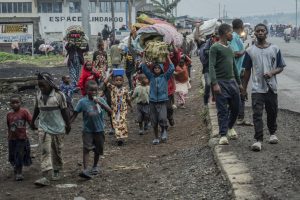
Daily life is unbearable for most Congolese in the occupied zone, with the constant risk of arrest, displacement or death.
Read about what IfE’s Congolese partners are doing about the situation, here.
After three years of gradually taking territory in North Kivu Province of the Democratic Republic of the Congo (DRC), in January 2025 the Rwandan-backed militia called M23 encircled and then took control of Goma. Goma is a city of nearly 2 million people, in addition to at least 500,000 recently displaced people, and is the administrative head of the province and the de facto commercial and military hub of the northeastern region of DRC. After solidifying their hold on Goma, the M23 next headed south into South Kivu Province and took over Bukavu, a city of around 1 million, which they invaded on 16 February 2025. Read a report on the invasion and how it is being financed, here.
Since that time, the M23, along with their Rwandan backers and their political arm called the Congo River Alliance (AFC), have set up an occupation government across the two provinces, and have continued to fight to acquire additional territory and resources. Although they have never been consistent in explaining their goals, the local Congolese population believe they are in the process of carving off the two eastern provinces to remain under permanent Rwandan control. While a small fraction of the population has defected and now works for the M23/AFC, the majority of the Congolese people in this region of the country are dead set against the Congo being “Balkanized” in this manner. Most residents of the occupied provinces support the Congolese armed forces (the FARDC) as well as the semi-organized coalition of citizen militias called the Wazalendo (‘Patriots’), who fight both independently and alongside the FARDC.
The situation of the people living in the occupied provinces is dire. Banks are shut down, supply chains are broken, unemployment is spiking, the economy is floundering, and all but the most basic health-care is unavailable. Policing has been redirected at enforcing the occupation’s rules, thus theft and violent crime are rampant. Arbitrary arrests, torture and killings by the occupiers are common. Forced recruitment through kidnapping, including of children, is used to replenish the ranks of the M23. Agricultural lands, forestry and mine sites have been taken by the occupying forces, and are exploited to support their invasion and occupation. A vast network of intelligence officers and spies monitor the population, and immediately target anyone who speaks out against the occupation. Daily life is unbearable for most Congolese in the occupied zone, with the constant risk of arrest, displacement or death.
#####