
IfE’s global response to the COVID-19 pandemic
Initiative for Equality’s first step when the COVID-19 pandemic broke out was to collect our best ideas through crowd-sourcing across our global network. We wanted to call for appropriate protective measures for the most marginalized and vulnerable people in the world.
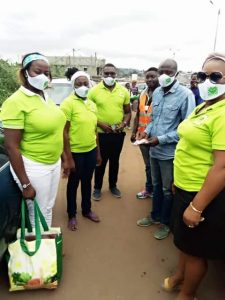
(IfE’s Pandemic Team in Libreville, Gabon, giving advice and masks to truck drivers)
First Project: Crowd-sourcing Recommendations to Protect Marginalized Populations
As a global network of organizations and advocates who understand the need for equality and participation, Initiative for Equality’s first step when the COVID-19 pandemic broke out was to collect our best ideas through crowd-sourcing across our global network. We did this so we could speak up and press hard for protections for the most marginalized and vulnerable people in the world.
The standard COVID-19 recommendations may not be helpful for:
* those who are so poor that they would starve if they didn’t go out looking for food each day;
* those who live in crowded slums and have no way to practice physical distancing;
* those who can’t isolate at home because they have no homes;
* those who are displaced – often living in huge camps with poor hygiene facilities;
* those in prisons or detention centers; and
* those who are not recognized as citizens (or even humans) by their societies.
Read our April 2020 crowd-sourced ideas from across the IfE network here. These ideas were contributed in response to the following prompts:
What are some immediate protective steps that people can take?
What needs to be done to protect people living in poverty during this pandemic?
How can we in civil society help these communities?
What steps must we demand that our governments take?
What can these communities themselves do to prevent the spread of coronavirus?
What systems, policies and practices must be changed, going forward into the future, to ensure something like this doesn’t happen again?
(Many of these recommendations were edited for clarity, or combined to prevent duplication.)
We followed up by combining these crowd-sourced recommendations with expert advice, developing a global petition calling for measures to be taken to protect the poorest and most vulnerable people in the world. See the petition and signatures here.
Second Project: Urgent Public Education and Advocacy on the Ground
Next, IfE rolled out a global project to address these recommendations on the ground. Thanks to the Balaton Group, a global consortium of systems scientists working for sustainability, IfE was able to work with thirteen member organizations in Africa and two in Brazil, giving them mini-grants to conduct public education and advocacy on behalf of the marginalized communities where they worked. The preliminary reports from these organizations arrived by early October of 2020, and were very heartwarming. Each organization took a unique approach to the project, depending on the circumstances, needs and cultural expectations in their communities. You can read the full report and see many photos here.
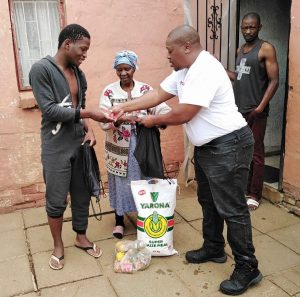
(IfE’s Pandemic Team outside Jo’burg, South Africa, handing out food to people who could not work.)
Third Project: Empowering Women with Equitable and Sustainable Responses to the Pandemic
Our next project, entitled Empowering Women with Equitable and Sustainable Responses to the Pandemic, was to build the capacity of women-led groups who are part of the IfE network to respond effectively to both urgent and longer-term needs of very poor communities during the pandemic, and particularly to the needs of women. This project, also funded by the Balaton Group, took place in 2021 and 2022, and was more demanding in terms of collecting and analyzing data to learn what women experienced during the government-led responses to the pandemic.
In this follow-up project, eight women-led organizations in Asia (Nepal and Pakistan) and Africa (Sudan and Democratic Republic of the Congo) were identified. They then received micro-grants to support their work on COVID-19 public education and advocacy, based on the materials from our Pandemic Response Statement and our first project. The eight participating organizations gathered information from women in their local communities, and brought it into a global discussion on advocacy needed to address women’s needs and rights during the pandemic. We also helped build capacity in these women’s groups, as well as collaborative working relationships among groups in our network.
Specific steps used to accomplish the above were as follows:
Each partner was asked to submit a proposal telling what they would do to learn the main problems women were experiencing due to the pandemic, and to provide helpful advocacy for women in their communities.
We collaborated to design a survey form to use with women in the communities.
Partners conducted the surveys and submitted their results, which were shared so we could all know what the main problems were that we needed to address.
Partners worked in the communities to provide accurate information and training to the women on covid spread and avoidance, and on how to respond to the problems affecting women that were being reported.
Finally, partners were asked to develop a long-term advocacy plan to empower women to see their needs met (as related to the pandemic response).
Findings of the Empowering Women Pandemic Project
The responses to the initial Questionnaire are provided below in Table 1, showing result totals for the 8 partners located in Nepal, Pakistan, Sudan and DRC. The names of partners and communities are not linked to these results for reasons of privacy and security.
Table 1. Results of Surveys among Women in the Communities
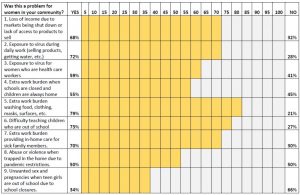
Detailed community-by-community results (not shown) indicated that there was substantial variability between the different communities, with women in the Asian communities less likely to report abuse and violence or unwanted pregnancies than those in African countries.
Advocacy Plans Proposed by Project Partners: Reducing Gender-specific Harms During the Pandemic
After collecting information in the communities located in Nepal, Pakistan, Sudan and DRC (reported above), members of the project were asked to develop plans to advocate for solutions in their communities. Here below is a compilation of their proposals, organized by general objectives and approaches.
Main Goal: To reduce gender-specific harms to women and girls that are made worse during the pandemic
Steps to take:
- Surveys to obtain information
Interview girls and women from each community
- Public awareness
Public educational meetings, private discussions, radio shows, distribute flyers
Educational meetings, distribute flyers
Open space awareness sessions about the impact of covid-19 on Women’s lives
Public lectures to educate women about gender-specific harms that are affecting girls and women during the pandemic, and to educate girls and women about their rights and how to protect themselves and other women.
Awareness episodes through the radio station and television on the gender-specific negative effects of the Pandemic and how to reduce these effects; target the General Public
- Women’s support groups
Create women’s support groups
Create support groups for women and girls who are providing midlevel health care services.
Organize meetings with groups of women and girls where women themselves will elect their representatives who are leaders, dynamic, available, capable of identifying the efforts that they are making themselves to respond to the various problems.
- Men’s support groups
Create men’s support groups to educate the boys and men about the situation of women and girls, and to help them understand about the moral and physical support they must provide to women during this period of the pandemic
- Advocacy & Mobilization of communities
Provide educational materials
Send a delegation of community members to meet with officials
Write articles or provide interviews for the news
Present radio shows
Picket (protest) with signs near their office
Run a candidate for political office
Advocacy and raising awareness
Zoom session on the gender-specific negative effects of the Pandemic to advocate for the wellbeing and safety of women and girls during the covid-19 pandemic ; target Stakeholders, Decision makers, health care workers, Practitioners and CSOs working in social protection, health and environment
Bring women together by organizing a conference of the various elected women leaders with the local authorities to draw up letters (request for support) addressed to the various organizations most concerned and which are at work in this community.
Present radio broadcasts
Place signs along the roads
Organize meetings (while respecting covid distancing measures)
Advocacy meetings with members of national government to implement policies to protect midlevel health service provider women and girls during and after pandemic.
Set up a commission (a group of women leaders) working in this same community where I work, who could contact the various authorized structures (public health services ; provincial health divisions ; Social Affairs Division ; local and international NGOs ; Humanitarian Aid Agencies)
Community Mobilization: Raise awareness, foster community empowerment, build community capacity to deal with the issue; target: general public, specific groups of people Indigenous people.
Authorities: Raise awareness, change behavior; target: general public, specific groups of people
Advocacy: Raising awareness, changing the social context through decision-making and policy development; target: specific groups of influential people
Advocating: Organize three days of advocacy to challenge political and administrative decision-makers to protect girls who are victims of sexual violence and to enforce the law enforcement; target: specific groups of influential people
- Reduce financial struggles
Provide training for 100 women on making non-disposable face masks, to help create income generating activities for women; target women from low income communities
Read more about this women’s project here.
References
https://www.initiativeforequality.org/coronavirus-protections-marginalized-vulnerable-people/
https://www.initiativeforequality.org/pandemic-response-must-build-equality-solidarity/
https://www.initiativeforequality.org/ifes-pandemic-response-advocating-womens-interests/
#####